
On July 29, musicians of the Three Choirs Festival will perform at Gloucester Cathedral. Included in their performance are two pieces by Cecilia McDowall: the orchestral version premiere of her A Song for St. Cecilia and Rain, Steam, and Speed (2006) for orchestra. A Song for St. Cecilia was originally commissioned by the Bar Choral Society for its 10th anniversary in 2024. McDowall’s original version was orchestrated for choir, mezzo-soprano soloist, two trumpets, and organ. The text was written by poet Kate Wakeling. Like many before her, she has drawn on centuries of mythology and mystery surrounding the historical figure, but has drawn much inspiration from the account of St. Cecilia’s life given in The Golden Legend or Lives Of The Saints compiled in 1275 by the Archbishop of Genoa and translated into English by William Caxton in 1483. Wakeling’s text celebrates Cecilia’s convictions more than the purity-for-its-own-sake that has traditionally followed her, making the saint a more active character in her own story. Rain, Steam, and Speed takes inspiration from Turner’s painting Rain, Steam and Speed, The Great Western Railway (1844). Originally commissioned by the Portsmouth Grammar School for the London Mozart Players, the piece celebrates the achievements of Isambard Kingdom Brunel—the Victorian civil engineer who designed the Maidenhead Viaduct (depicted in Turner’s painting), the Clifton Suspension Bridge in Somerset, and the Great Western Railway that connects the Southwest, West, and West Midlands of England to both London and Wales. In her musical depiction the scene, McDowell has chosen to evoke the meeting of the pastoral and the industrial instead of going for a programmatic or narrative structure. Unlike many other pieces of art depicting industrialization in Britain, she writes the railway and countryside converging into a new future instead of opposed to each other in an ideological fight to the death.
Below is a recording of Rain, Steam, and Speed by the Meadows Chamber Orchestra in 2022.

Liza Lim, composer Credit: Fiona Wolf, studio Jan 2026
From July 24 – 31, the Sydney Chamber Opera & Carriageworks, in association with ELISION Ensemble will perform Liza Lim’s The Oresteia. This is the first production of the opera after its 1993 world premiere in Melbourne. The same characters of Aeschylus’s original—Electra, Cassandra, Orestes, Clytemnestra and Agamemnon, and with all the foibles audiences remember them for—return to the stage for a striking, minimalist production. One critic observed that it offers “no soft options for the audience: confronting, cathartic and challenging” while also calling it “visceral, confrontational, and totally compelling.” Audiences expect no less from Lim: she is one of the landmark voices in Australian contemporary music, and recently won the 2026 Grawemeyer Award for Music Composition— the highest international honor for new music—for her work A Sutured World for cello and orchestra (2024).
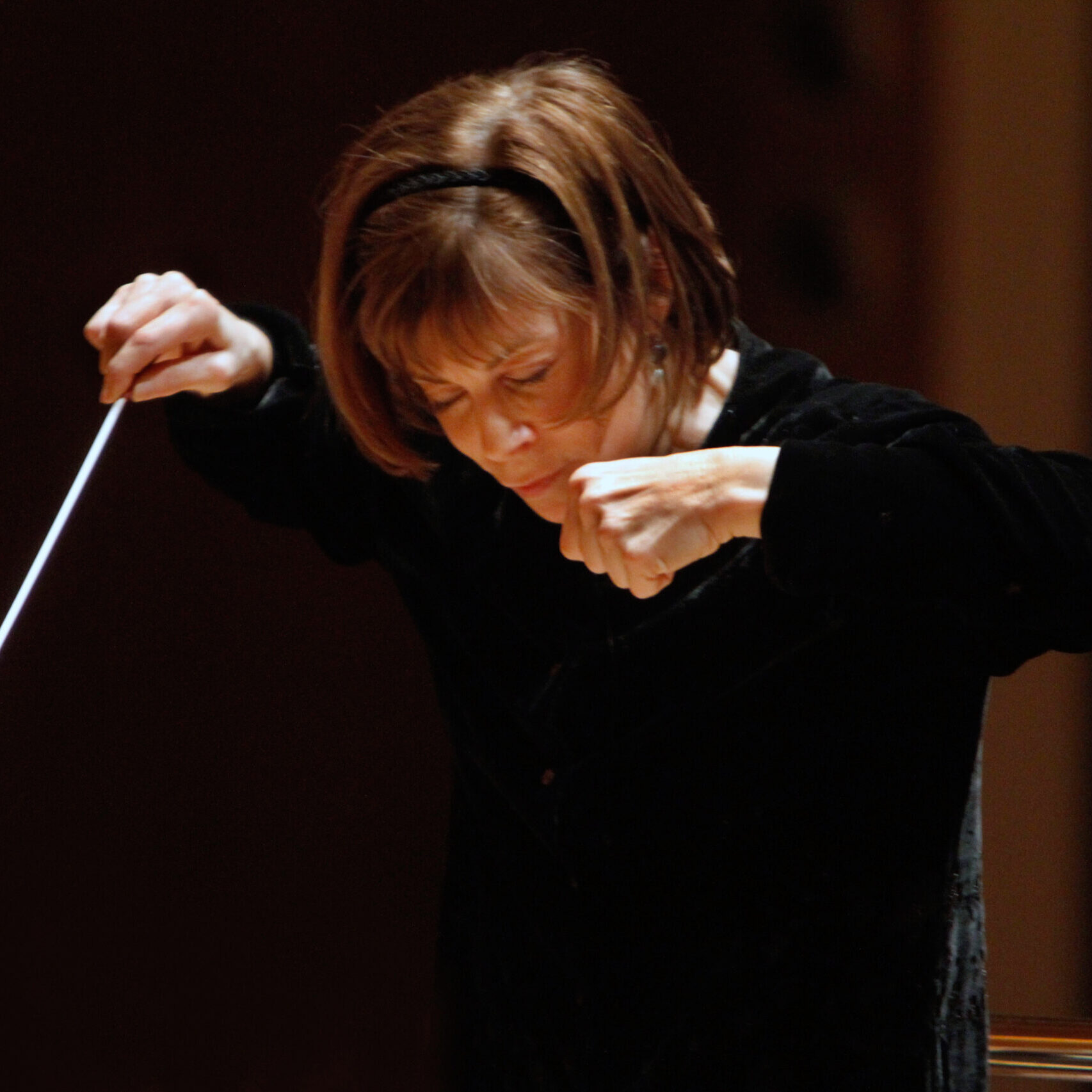 On August 2, JoAnn Falletta conducts the World Youth Symphony Orchestra in a program at Interlochen that includes Margaret Brouwer’s The Art of Sailing at Dawn (2020). An evocative and wind instrument-forward work for chamber orchestra, The Art of Sailing at Dawn uses both Romantic-era and Impressionist instrumental tropes as well as contemporary musical language to depict a seascape. The work may be streamed directly through the composer’s website. The concert may be heard live via Classical IPR at 7PM on August 2 following some pre-concert interviews; 88.7 FM Interlochen / 94.7FM Traverse City / 88.5 FM Mackinaw City.
The deadline for the International Alliance for Women in Music’s (IAWM) J. Michele Edwards Conducting Award has been extended to August 1. The award recognizes achievements in gender equality in the concert hall, and is open to any conductor or performing ensembles currently members of IAWM. In addition to founding the award, Edwards has done important work in feminist musicology, conducts the eighty-voice Minnesota Center Chorale and Calliope Women’s Chorus, and is Professor Emerita of Music at Macalester College. She is co-author with Leta E. Miller of Chen Yi in the University of Illinois Press’s Women Composers series (UI Press, 2020).

Sarah Hennies, composer & percussionist
From July 27 – August 10, the 64th season of the Cabrillo Festival of Contemporary Music is under way in Santa Cruz, California. The Festival’s Creative Lab commissioned artist Sarah Hennies will premiere her new work for large orchestra, The Grain House, as part of the festival on August 1. This is particularly exciting as Hennies has made much of her reputation as a composer writing for smaller ensembles of all instrument combinations. Her skill in writing chamber music makes me very hopeful that she will not limit her writing to re-hashing the forms and tropes that audiences are used to hearing from large orchestras. Recently, Hennies gave an interview to the magazine I Care If You Listen, discussing her compositional practice in recent years, influences, and what it’s like to enter the world of composing for large orchestras. Also at the Cabrillo Festival, on July 28 composers Kai Kubota-Enright and Zoe Verduin will have new works for orchestra performed as part of the festival’s “In the Works” Concert, which will be live-streamed on the festival YouTube channel.
This week at the BBC Proms there are four works by women composers scheduled, including one premiere. On July 27th, Kristine Tjøgersen’s Between Trees, performed by the London Philharmonic Orchestra; July 29th, Judith Weir’s Moon and Stars, performed by BBC Scottish Symphony Orchestra; July 30th, Dobrinka Tabakova’s Orpheus’ Comet, performed by the BBC Scottish Symphony Orchestra; and on August 2nd, the world premiere of the BBC co-commission SIGNAL Concerto for Brass by Dani Howard. As Sarah Baer reported in WPA’s recent analysis of the 2026 BBC Proms lineup, the women whose works are being played this week are four of the twenty-two contemporary women composers whose work has made it onto Proms programs this year.
Let us know who you’re listening to! Email us at info@wophil.org