
By Sarah Baer, with information provided by Sandy Lewis, WPA Board member 
The 2026 BBC Proms begins in London on July 17 and run through September 12, offering hundreds of hours of music spanning genres and centuries of history. This historic and deeply beloved tradition makes attending concerts a family affair with accessible tickets and a casual atmosphere, reinforcing that classical music is for everyone.
The history of women at the Proms is fascinating – Sir Henry Wood, the founder and conductor of the Proms for many years, commissioned many works from British composers during his tenure, including British women. However, the first woman to receive the honor of conducting the Last Night of the Proms, Marin Alsop, only did so in 2013.
As with the U.S. Orchestra Repertoire report, the BBC Proms repertoire report gives us a sense of what is happening across the pond, so to speak. For comparison, the 2025 BBC Proms repertoire report can be found here.
In the 2026 Season programming, which is available online here, offers a tremendous wealth of information that we analyzed in compiling this data. Some information, however, is incomplete. For example, while timings were available for most pieces, they were not included in every piece. Not every concert listed included titles of pieces and composers as final decisions are being made – it also looks as though the final repertoire for the Last Night of the Proms is still being decided. It’s also important to note that, just like our Repertoire Report on American Orchestras, we are interested in symphonic programming, not choral concerts, children’s events, or other musical styles or genres.
The Numbers
With that said, we calculated a total of 5,391 minutes of music in the coming season – which is almost 90 hours. There will also be a total of 252 individual works by 145 composers heard throughout the season.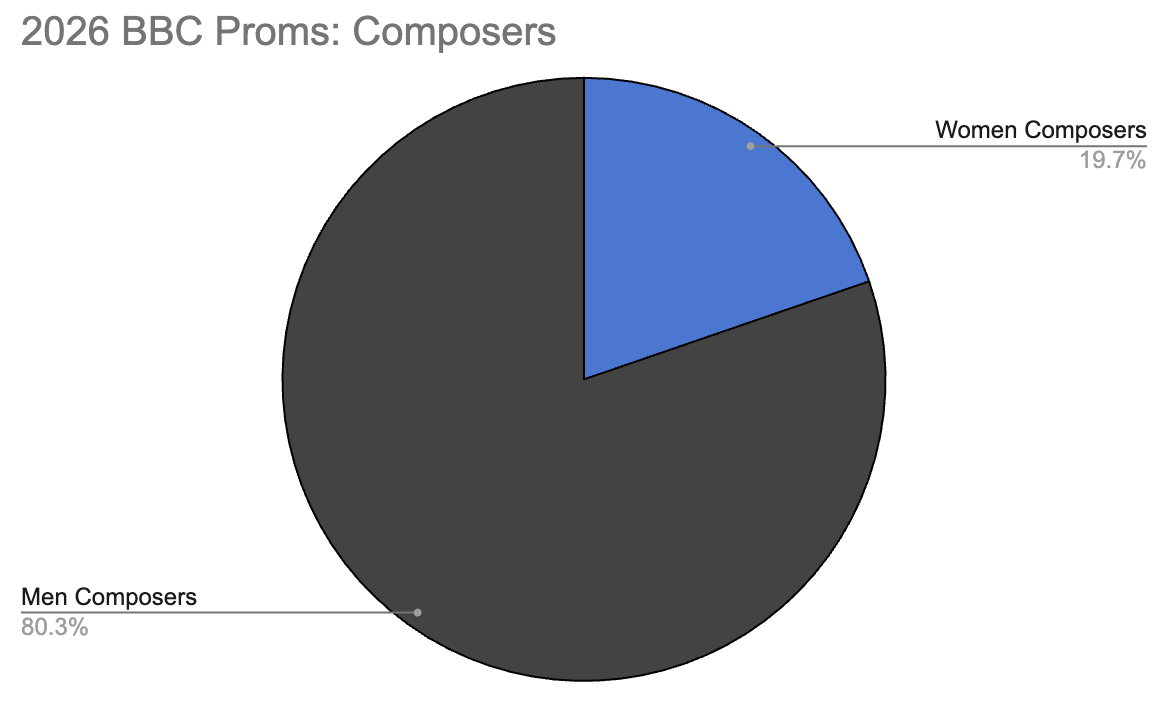
Of those 145 different composers, 29 are women for a total of 19.7%. This is a slight increase from the previous year, but still lags far behind the figures from the 2024 season where women composers made up a total of 25%. You can find a listing at the bottom of this article with all of the opportunities to hear works by women in the coming Proms programming.
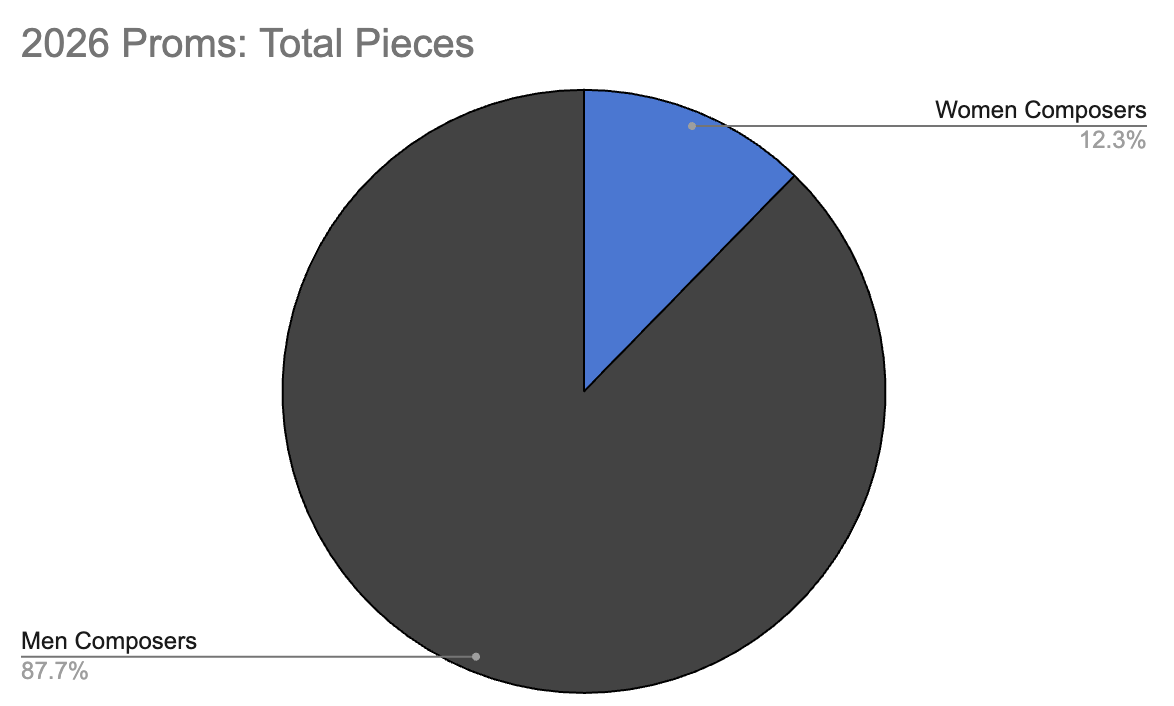
There will be a total of 252 individual pieces being performed this coming season. There are a total of 31 works by women being heard this season – this is 12.3% of the total, which is again a slight increase from the 2025 season, where works by women only made up 11.9%.
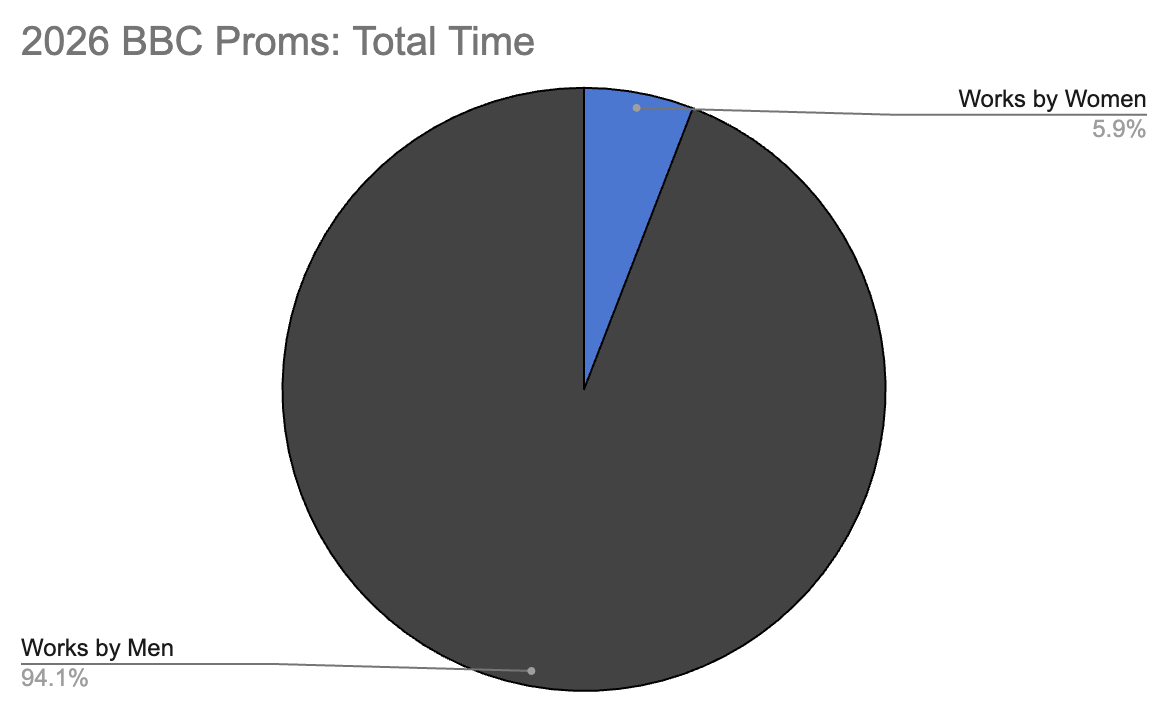
As mentioned above, one of the most important data collection points when considering equity in repertoire is the length of the piece, itself. It is not just that the number of women composers is equal to the number of men composers on any given concert, it is that they are given equal time. The 2026 Proms season will feature 317 minutes of music composed by women – about five hours. This is compared to the 5,074 minutes that work by men will be heard – 84.5 hours. The 5.9% of time that women receive is less than the previous two years, where works by women were heard 7% of the time.
The longest piece by a woman composer in the coming season is Gabriela Ortiz’ Revolución diamantina which is timed at 42 minutes. The average length of a work by a woman composer in these programs is about 10 minutes. In comparison, average length of a work by a man composer is about 23 minutes – this includes Berlioz’s The Damnation of Faust at 130 minutes, Strauss’ Ariadne auf Naxos at 120 minutes, and Weber’s Oberon at 120 minutes.
The roster of historic women composers is (unsurprisingly) short. The third movement from Florence Price’s Symphony No. 1 will be heard (we are wondering if this is the only time in the Festival a multi-movement work is excerpted?) as well as pieces by both Lili and Nadia Boulanger, Louise Farrenc, Grażyna Bacewicz, and Vítězslava Kaprálová.
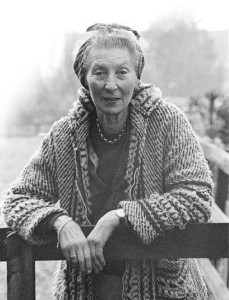
Elizabeth Poston
A surprising addition to what has been largely understood as standard repertoire is a choral piece by Elizabeth Poston – an English composer and pianist, who composed extensively, including scores for radio and television productions, and has become quite famous for her Christmas Carol “Jesus Christ the Apple Tree.” Childhood friends with E.M. Forster, Poston attended the Royal Academy of Music where she was encouraged to compose by Ralph Vaughan Williams. A respected performer as well as composer, her choral arrangement of the folksong The Water of Tyne will be included in the Proms programming this year (but it does not figure into our statistics, which are of orchestral programming).
In the same vein, two choral arrangements of works by Hildegard von Bingen will also be heard in the coming season, offering opportunities for audiences to engage with music from one of the first known women composers.
Though there are certainly disappointments in terms of equal time and attention in this year’s programming, what can be celebrated is the inclusion of so many – a total of 22 – contemporary women composers, some of whom are just entering their professional careers. These include Josephine Stevenson, Elaine Hagenberg, Shruthi Rajasekar, Bushra El-Turk, Kristine Tjøgersen, Carmel Smickersgill, and Dani Howard. Also present are some more familiar, senior living composers such as Judith Weir, Judith Bingham, Meredith Monk, Imogen Holst, Édith Canet de Chizy, and (with the premiere of a bassoon concerto) the 98-year-old Thea Musgrave. A full chronological list of the women composers and conductors included in orchestral programming in this year’s Proms is appended below.
Conductors
In addition to considering the works performed, we also like to consider who is being asked to step unto the podium. Though the percentage of women conductors is making wonderful progress – with many thanks to organizations like the Taki-Alsop Foundation who have led the way in addressing the systemic obstacles that exist for women conductors – we are still far from true equity.
Of the 58 conductors that will take the baton this coming season, 9 are women – a total of 15.3% and a tremendous decrease from last year’s 22%. They will conduct a total of 635 minutes of music, which is 11.7% of the total. The women who will take the podium this season are:
Alice Farnham
Anja Bihlmaier
Dalia Stasevska
Delyana Lazarova
Elena Schwarz
Maria Włoszczowska
Marin Alsop
Mirga Gražinytė-Tyla
Miho Hazama
See below for a listing of when these women will be at the podium.
Concluding Thoughts
The reality is that this is a disappointing Proms across the board. There are fewer women composers, fewer works by women, less time in performance, and fewer women leading ensembles. Just as we saw in the 2026-2027 Repertoire Report, the work of the classical music world towards expansive, inclusive, and exciting programming has largely reversed course. Yet, through the frustration and disappointment this causes, it is vital to remain steadfast to our belief in this work, the value that classical music – and the arts more generally – and equitable representation therein, are important for the future that we wish to build.
In last year’s report I included a short playlist of works by British women composers as a reminder of the tremendous history – and future – that exists within the works of women composers. I’m including it again below to further reinforce the possibilities not only of future Proms, but of concert hall repertoire, music education curricula, and ways to participate with art in the world.
First night July 17 – Josephine Stephenson (new work), Dalia Stasevska conductor
July 19 – Judith Bingham, Four Minute Mile
July 20 – Jessie Montgomery, These Righteous Paths
July 21 – Betsy Jolas, Tales of a Summer Sea
July 23 – Lili Boulanger, Vielle prière bouddhique
July 25 – Karen Ní Bhroin conductor
July 27 – Kristine Tjøgersen, Between Trees
July 29 – Judith Weir, Moon and Star
July 30 – Delyana Lazarova conductor
Aug 2 – Dani Howard, Concerto for Brass ‘SIGNAL’
Aug 4 – Elena Schwarz conductor
Aug 5 – Nadia Boulanger, Fantasy for Piano and Orchestra
Aug 7 – Nil Venditti conductor
Aug 11 – Caroline Shaw, Partita – Sarabande and Héloïse Werner, (new work)
Aug 12 – Gabriela Ortiz, Revolución diamantina
Aug 18 – Édith Canet de Chizy, Skyline (concerto for 3 percussionists, timpani and orchestra)
Aug 20 – Miho Hazama conductor
Aug 21 – Anja Bihlmaier conductor
Aug 23 – Thea Musgrave, Bassoon Concerto, “Out of the Darkness”
Aug 24 – Joan Tower, Fanfare for the Uncommon Woman, Marin Alsop conductor
Aug 29 – Mirga Gražinyté-Tyla conductor
Sept 1 – Vítězslava Kaprálová, Suita Rustica
Sept 4 – Carmel Smickersgill, A Brick Thrown with Love
Sept 5 – Louise Farrenc, Overture No. 2