We continue with part 2 of the series begun here with “Gabriella Lena Frank is having a long moment.” Attendees at next week’s ACSO (Association of California Symphony Orchestras) conference will have the oportunity to hear Frank as Keynote speaker, as well as hearing two of her works be performed by the Santa Rosa Symphony
By Sarah Clemmens Waltz
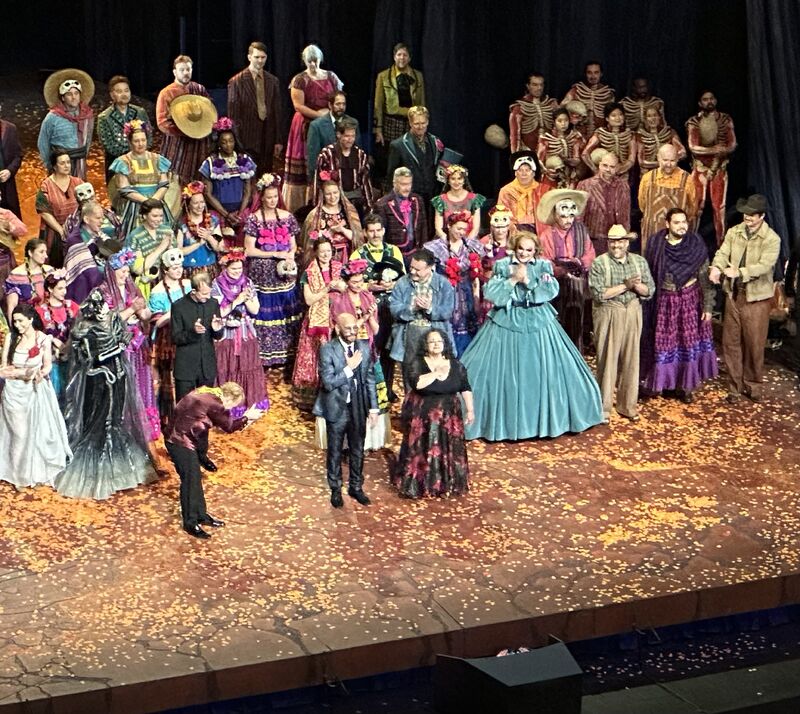
Curtain Call at the Met
Pulitzer Prize winner Gabriela Lena Frank just became the first woman of color to have an opera, El Último Sueño de Frida y Diego, produced at New York’s Metropolitan Opera. For some students at my university who had the opportunity to travel 2,864 miles to the Met, it was perhaps the first live opera they had seen apart from their own productions. As I discussed in part 1, Frank’s work with students at the University of the Pacific this year, a residency building on previous connections, has been an unprecedented opportunity.
In a lecture as part of this residency, Frank repeated the lifeline she hands to students: “When I sometimes hear young composers say, ‘I don’t know enough,’ I often say, ‘I think you do. You can go ahead and get started’ [36’53”].” This “engraved invitation” goes beyond permission to model Frank’s self-assurance; it applies to the technical elements of music-making, recasting “failure” as a necessary component of experimentation. She spoke of her occasionally cringe-worthy experiments that nevertheless taught important practicalities (like how to write for violin). On the question of how she found her voice, Frank answered one student starkly: “My friend, I wrote a lot of bad music first that will never see the light of day” [Q&A, 53’56”].
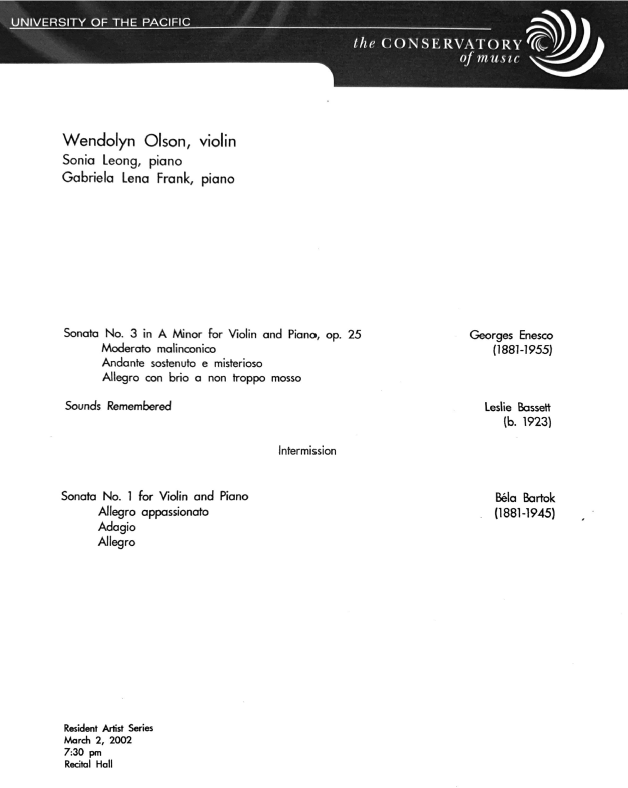
Frank’s rare talent for demystification builds further confidence. She freely details the “how-tos,” speaking of having daily compositional “warm-ups” or exercises, like études. For example, she noted setting herself the arbitrary task of writing a transition from a favorite work like the second movement of Bartók’s second string quartet to, say, the finale of Mahler’s Symphony no. 4. (Incidentally, Frank’s love of Bartók is well documented; a faculty member who knew her at Rice, Patricia Shands, remembers coaching her in Bartók’s Contrasts, while pianist Sonia Leong sent me a 2002 program of Frank performing Bartók’s first violin sonata with violinist Wendolyn Olson [see image at end].) Frank considers that this essential and playful habit gets her “in shape” for composition. It’s also completely practical, as such wild and weird transitions with their orchestrations can be saved for future work. Miranda Duarte, a recent graduate in voice and composition, took to heart both this concrete advice to keep notebooks and Frank’s suggestion to protect creative time as a performer protects practice time—as well as taking time for personal development and “to think about what I want to create.”
Young people find liberation in knowing that experience comes as it comes. Pacific alumna Mary Denney, who just completed the M.M. in composition at Frank’s alma mater (University of Michigan), recalled some formative advice she received in lesson in a previous residency with Frank, “In that lesson she told me: ‘the only difference between you and me isn’t talent, it’s time.’” It’s advice that Denney credits for her own first orchestral premiere this year; Frank’s timely encouragement inspired her “to write a much more personal yet overtly feminist work than I might have written otherwise,” in part because “she isn’t afraid to put her full self on display in her work. She exhibits a level of authenticity in regards to her heritage and identity that I think few composers have risen to, and to infuse it into the relatively conservative genre of orchestral music is where her brilliance lies.”
I have personally been most struck by Frank’s invitation for students to view their tight-knit conservatory community as their future network. It has been years since our most famous alum (so far), Dave Brubeck, died, and his story of swimming upstream as a jazz musician at a conservatory sometimes feels distant to today’s students. Frank’s example is a more present reminder that students can be who they are right now; they do not have to catch up to and surpass Juilliard students first. Our connections are not some luminaries we meet in the future but the stars born around us now.
Over and over, student Q&A sessions with Frank focus on how to find a voice, how to feel comfortable representing a racial identity you don’t even feel that you fully inhabit—questions that Frank answers candidly, optimistically, generously, and literally. She says, characteristically, “The voice is a byproduct of honest work. If you focus on the work, it’s going to materialize” [Q&A, 57’58”]. Her tips land extra-well with women and students from minority backgrounds, but they tend to be true and useful for everyone; it sometimes seems only a bonus (if an important one) that she does this as a woman of color. Denney expressed a relevant frustration on this point, that “even with the prolific output and achievement she’s reached, I only ever see her celebrated as one of the greatest living female composers as a qualifier, and not simply one of the greatest living composers, period.” Navigating this old double-bind—as well as honoring the aspects of her identity that she celebrates, without reducing her to only those elements—is maybe best done by listening to the music.
Because it doesn’t hurt that Frank’s music also resonates with listeners. Pacific students who performed her Elegía Andina in 2023–4 quickly got over any preconceived distaste for contemporary music. This year conductor Sebastián Serrano-Ayala described her coaching of the student orchestra in Escaramuza, which she acknowledged was a difficult work for them. Serrano-Ayala said, “She has a remarkable way of encouraging performers to be theatrical, engaged, and specific, while also reminding us to distill the music to its most essential character.” They were of course thrilled to be playing music by a living composer who was in the room, but also by the double encounter with her compelling voice—through the music and through herself. Serrano-Ayala was also struck, as so many are, by Frank’s giving of herself: “What stayed with me most was Gabriela Lena Frank’s generosity and clarity in rehearsal. Her comments helped us understand the piece not only as a vivid orchestral score, but as a deeply personal musical language shaped by identity, memory, rhythm, and storytelling.” As, historically, the lack of ability to experiment with an orchestra is one of the major factors preventing women composers from developing an orchestral voice, it is striking that Frank’s permission to experiment is accompanied by generous feedback with performers as well as composers. And clearly this has always been her nature, as demonstrated in the chapter Deborah Hayes contributed about Frank to the 2011 book Women of Influence in Contemporary Music: Nine American Composers (ed. Michael K. Slayton).
Apart from all the other lessons students learned about orchestral playing beyond the notes in Escaramuza, Serrano-Ayala explained that they also encountered “the responsibility of bringing a living voice into the room.” Students who attended the Met performance of Frida y Diego continued that lesson in a meal with the composer beforehand. Composer Andrew Conklin noted that discussion turned to the mind-boggling amount of expertise—and thus collaboration—that goes into any creative act, especially an opera production which combines extremely niche areas of knowledge about stagecraft, vocal production, costuming, etc. The fact that such daunting expertise can be parceled out among contributors and brought together in a work was more inspiring than daunting to the students.
In my attendance of the simulcast of the same performance, I noted that operagoers also reap the benefits of Frank’s generosity and collaboration in this colorful, engaging, even riotous Gesamtkunstwerk. They are allowed to revel in textures and sounds—the crystalline piccolo half-steps, the subtle marimba accompaniments—as well as in the visual chromaticism we expect in a work about artists and in the imaginative collision of lives and mythologies in the libretto. Frank’s work makes her lessons ring true.