
Our distinguished guest blogger today is Sarah Clemmens Waltz, a musicologist with a wide range of research interests. She is Professor and Program Director for Music History at the University of the Pacific at Stockton, CA. Her insights on Gabriela Lena Frank are a timely follow-up to the composer being awarded the 2026 Pulitzer Prize in Music.
Gabriela Lena Frank was 10 years old in 1983 when the Pulitzer Prize in music was awarded to a woman for the first time, Ellen Taaffe Zwilich, for her Symphony no. 1. By the time Frank was 20, American composer and critic Kyle Gann was begging the Pulitzer jury to “include more diverse composers than the dying breed of Eurocentric expressionists,” concluding his essay: “What are they afraid of—that a piece audiences enjoy might accidentally win?” (“Composer’s Clearinghouse: the Pulitzer Prize,” Village Voice, May 5, 1992.) It was still many years before this call was taken up, though evolving into an almost dizzying diversity in recent years. Perhaps not coincidentally, women’s names—including Jennifer Higdon, Caroline Shaw, Du Yun, Rhiannon Giddens—have been increasingly among the winners, though Frank’s 2026 Pulitzer win for Picaflor: A Future Myth is the first to follow directly on another woman’s win (Susie Ibarra’s Sky Islands). And I hope Gann would agree it’s a piece audiences enjoy.
Picaflor just premiered in March with the Philadelphia Orchestra under Marin Alsop and is dedicated to Kaija Saariaho. This ten-movement, thirty-minute orchestral work is a joint commission from the Philadelphia Orchestra (where Frank has been completing a residency), the Oregon Symphony, and the Bravo! Vail Music Festival. (If you’re scouring YouTube for the work, you might need to wait until those ensembles’ premieres later this year; meanwhile Elegía Andina or Escaramuza may tide listeners over. A link to the score, however, is here.) Currently, Frank is attending rehearsals in New York for the May 14 Metropolitan Opera premiere of her El Último Sueño de Frida y Diego, a collaboration with Nilo Cruz some 15 years in the making. Unlike the Met’s recent commissions of Jeanine Tesori (Grounded, 2024) and Missy Mazzoli (Lincoln at the Bardo, on the 2026–7 season), Frank’s Frida y Diego has already seen great success in San Diego, Los Angeles, and San Francisco in 2022–3. It will also be the first opera by a woman of color in the Met’s long history (and, in its interaction between the world of the dead and the living is a nice parallel to Corigliano’s 1991 Ghosts of Versailles, an earlier crack in the armor of the Met’s enshrined canon).
It’s a big moment for Frank, then, and one that’s the result of steady momentum over many years. It has also unexpectedly created a big moment for my students, whom she’s generously aided this year in her residency at University of the Pacific in Stockton, California, not far from her roots in Berkeley and her first residency in nearby Modesto. Seeing some of these interactions and how her words strike these students demonstrates that her power, for them, goes far beyond “Local Figure Makes Good” or even “Person Who Looks Like Me Can Succeed.”
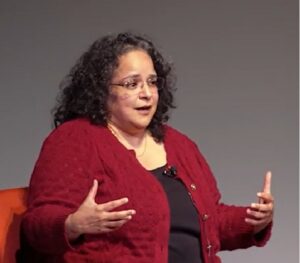
Gabriela Lena Frank speaking at University of the Pacific
Power is an appropriate word, as Frank likes to go big in composing. As she noted concerning her early large-scale works in the University’s Presidential Speaker Series, “It was important to me to take space” [Q&A, 47’30”]. Of course, she also represents a multi-layered identity that can be considered both truly American and truly global. She tells the story of her father’s Lithuanian-Jewish heritage and her Peruvian mother with a Chinese grandfather as an American one. The Peruvian-Chinese heritage is not so unusual in Peru, though it complicates American ideas of “Hispanic.” Students of color at our Hispanic-Serving Institution, however, include not just many self-described mestizos but very many AAPI (Asian American and Pacific Islander) students, and not a few who are both; they are often mystified by national discussions of diversity that seem (sometimes literally) black-and-white, and as one student noted, many frequently feel that they aren’t “enough” of anything to have a defined identity.
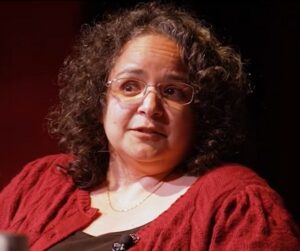
Gabriela Lena Frank speaking at University of the Pacific
Still, it’s not so much Frank’s heritage as her comfort with herself and willingness to fail that remedy this feeling. For instance, she speaks in the same lecture of confidently writing one of her first songs (on a text by Jose Maria Arguedas) in Spanish and the Peruvian indigenous language Quechua, before she had even been to Peru [36’05”, including performance by Heidi Moss Erickson and Sonia Leong]. But it became a source for her later work, as she explained: “If you had told me a student work would bring me to the Met 27 years later, I would not have believed you.” There is a double lesson here, the first in self-assurance — even chutzpah — being an important foundation to composition. But the second lesson is even more broadly inspiring: The “moment” of success that Frank is inhabiting has had a long gestation and rise. When every field heralds its “30 under 30” it’s a relief to see that some rewards take time to reap, especially for nontraditionally aged students or those working through hardships and disability.
Indeed, disability is a part of Frank’s identity that she does not typically center, although she does not avoid it either. In her 2020 interview with the New York Times, she mused on the physicality of deafness in Beethoven’s piano sonatas and the introversion produced when she takes off her hearing aids, when her “imagination goes to different places… like being in a dream where unusual and often impossible events come together.” But more Beethovenian than her congenital hearing loss are Frank’s sense of scale and refusal to ask permission to bring forth “all that I felt was within me,” as Beethoven wrote in the Heiligenstadt Testament.
Another element, one that is meant to come through in Picaflor, is her environmental concern. For someone like Frank who has watched the transformation of Californian weather over the last half-century, the catastrophic fires of the last several years represent a cataclysmic transformation; Californians who have evacuated, lost homes, or watched Yosemite burn can relate. Picaflor marks the time between “pachacuti,” or (to paraphrase the publisher’s description) the cataclysmic transformations that era-worlds undergo every few hundred years. Picaflor is the little Peruvian hummingbird, flower-picker, which in Frank’s telling plays a role in creation and, after (our own?) apocalyptic pachacuti, re-creation. This fanciful invention plays with time, like an idea she suggested for a potential opera that would feature a time-traveling Don Juan. Not just students but audiences are clearly drawn to this unapologetic play of imagination.
Frank’s generosity of spirit and sincerity have been noted by many who have worked with her, and in part 2 of this post I will explore some of the advice and modeling she has given young composers that help demystify composition for large ensembles.
[Score for Picaflor: A Future Myth here.]