
By Liane Curtis
As part of our series, Paying it forward / paying it backward, earlier this year, June 17, I met (via Zoom) and talked with composer Dr. Xi Wang. This was suggested by our dear Board member Chen Yi, who was a teacher of Xi Wang (as you’ll read below). Dr. Xi Wang is Professor at the Meadows School of the Arts of at Southern Methodist University. We had a fascinating discussion focusing on her plans for the fall, and also on her very interesting background. After some introductory conversation we jumped right into her upcoming plans.
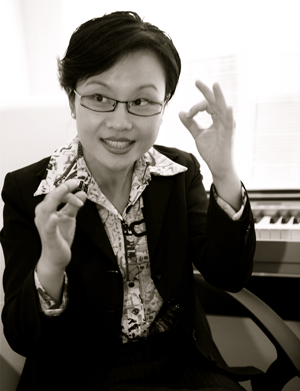
Dr. Xi Wang, composer. Photo credit: Eason Kong
Xi Wang: In September, I’ll be attending the Copland House Residency, where I’ll spend about a month.
Curtis: Oh! And where is that?
Xi Wang: The Aaron Copland House is about an hour by train from New York City. I was fortunate to be selected for this year’s Residency Award. Then, starting in September, I’ll travel to Chicago monthly to work with the Grossman Ensemble, a chamber group at the University of Chicago’s Chicago Center for Contemporary Composition. I’ve been commissioned to write a piece for the ensemble, which will premiere in December, and these visits allow me to rehearse excerpts and refine the work collaboratively with the musicians.
Curtis: Well, if you could just go back in time and tell me a little bit about your background. I guess you started playing very early?
Xi Wang: Yes, I started out as a pianist. My parents, like Dr. Chen Yi, were born in the 1950s and lived through the Cultural Revolution. Both originally from Shanghai, they were sent to the countryside around 1968 when they were just teenagers. It was a defining experience for their entire generation.
Curtis: Wow!
Xi Wang: I was born in 1978, shortly after the Cultural Revolution, in Nanchang, where my parents had settled because they couldn’t return to Shanghai after the Cultural Revolution. I was an only child, just as the one-child policy was beginning. Since both my parents had been forced to leave school as teenagers, they were determined to give me a good education.
My father worked at a museum that had an old piano. A neighbor who was a musician noticed that I could pick up melodies and rhythms by ear, so my parents felt I might be able to become a musician. So my father borrowed the museum’s piano for me to practice on. A few years later, I placed third in a national children’s keyboard competition, after winning at the regional and provincial levels.
Curtis: So interesting!
Xi Wang: That’s how I started out, as a pianist. When I was ten, I auditioned for the Shanghai Conservatory but wasn’t accepted, partly because my hands were considered too small. At the time, piano training was heavily influenced by the Soviet traditions, and students were expected to reach an exceptionally high level. The Shanghai and Central Conservatories, the two top schools in China, each admitted fewer than ten children, with the expectation that they would eventually represent China in international competitions. Education was free, but the selection process was extremely competitive.
Curtis: So competitive!
Xi Wang: It was extremely competitive, but the conservatory offered free education with boarding. They selected only a few pianists nationwide each year, starting in fourth grade through graduate school. When I was rejected at ten, we didn’t give up. My Chinese teacher noticed that I had a strong imagination and a talent for writing stories, and suggested that I might become a composer.
My parents had already invested everything in my musical education, even going into debt to buy me a piano when I was around seven years old. So I began studying composition at eleven, and by twelve, I was accepted into the Shanghai Conservatory as a composition student, entering its system in seventh grade and continuing from there.
Curtis: And that was a boarding school. It’s total immersion?
Xi Wang: Yes, absolutely. Students came from all over the country, selected as the best young musicians, so we all lived on campus and went home only twice a year, during winter and summer breaks. That was how my conservatory education began.
Curtis: Wow. Intense! Then, when did you come to the US?
Xi Wang: After completing my undergraduate degree at the Shanghai Conservatory, I came to the U.S. in 2001 to study at the University of Missouri–Kansas City with Dr. Chen. It was actually the only school I applied to.
Curtis: Oh, really?
Xi Wang: It was 2001 and I didn’t know how to use a computer. The computer and internet were new to me. And my English was bad.
At that time I had two options available to me. One was to stay in Shanghai Conservatory for graduate school, because I was a top student at the time. I became the top student for my grade, and I was already promised a teaching job at Shanghai Conservatory once I finished my graduate study, but I thought it was probably too safe for me to stay, and I wanted to see what’s in the other part of the world.
In 2001, I barely knew how to use a computer. The internet was still new to me, and my English was very poor. I had two options: stay at the Shanghai Conservatory for graduate school, where I was a top student and had already been promised a teaching position after graduation. Or to venture into the wider world. Staying would have been the safer path, but I wanted to explore what lay beyond China.
Curtis: Yes, of course!
Xi Wang: My composition professor at Shanghai Conservatory knew Dr. Chen personally and introduced us. I applied to the University of Missouri-Kansas City (UMKC), where Dr. Chen teaches; it was the only school I applied to. I didn’t have any relatives in the US, and I was terrified at the thought of moving to a new country without speaking much English. I was accepted by UMKC with a full scholarship! That’s how I came to the United States, thanks to Dr. Chen.
Curtis: That’s great!
Xi Wang: At UMKC, I studied with Dr. Chen Yi, Dr. Zhou Long, and Dr. James Mobberley. After completing my master’s degree, I went to Cornell University for my doctorate, where I studied with Steven Stucky.
Curtis: I guess Cornell was different from UMKC?
Xi Wang: Yes, they were very different experiences, and both were fascinating. I met Steven Stucky just two weeks after arriving at UMKC. He was visiting as a guest composer, giving a concert, a master class, and presentations. At the time, I barely spoke English and was almost completely silent, but he saw my music during the master class and liked it. He encouraged me to stay in touch and told Dr. Chen that I would be very welcome to apply to Cornell for my doctorate.
By the time I arrived at Cornell, I had known him for two years. Like Dr. Chen, he was an incredibly caring and supportive mentor. I was fortunate to have two such wonderful professors.
Curtis: That’s so nice!
Xi Wang: I was incredibly fortunate to have them both in my life. They nurtured and supported me, opened doors for me, and guided me in every way—not just as professors, but almost like parents.
Curtis: That’s wonderful. So you had a good experience.
Xi Wang: I’m deeply grateful for the professors I met in the United States. They made an enormous difference in my life and career.
Curtis: So now you go back, your family’s in China, still?
Xi Wang: My parents still live in China, but I’ve built my own family here in the U.S. I met my husband in Dallas, and we have two children—a boy and a girl.
Curtis: And how old are they?
Xi Wang: My son is 13, and my daughter is turning 12 next week.
Curtis: That’s so exciting.
Xi Wang: It’s been challenging to balance a full-time teaching career, commissioned compositions, and raising two children. It’s a lot to manage, but it’s also been a meaningful part of my journey.
Curtis: So about your music, I looked a little at your website, and some of the pieces. But, our question is whether you are influenced by the past and relationship to historic composers? … So,, have you been influenced by historic composers? I mean, I think you’ve written some specific pieces dedicated to composers of the past …
Xi Wang: Classical music has always been a major influence on me. I grew up playing the standard repertoire, but hearing Stravinsky’s The Rite of Spring in high school was a real turning point. Then, when I was about 20, I heard Ligeti for the first time. I was amazed that music like that even existed. It completely changed how I thought about harmony, tone color, texture, and melody.
Bartók and Shostakovich also had a profound influence on me. Later, I was drawn to composers with very different approaches to sound and form, such as Xenakis and Takemitsu. I also love Aaron Kernis’s music, and I wrote my doctoral dissertation on his Symphony No. 2.
Curtis: Oh, I see.
Xi Wang: My professors, Steven Stucky and Chen Yi, also had a profound influence on me, as did Christopher Rouse. At the time, I was fascinated by the musical languages of these living composers. I also love Jennifer Higdon’s music. The first piece of hers I encountered was Blue Cathedral, which remains one of her most frequently performed works, and it opened the door to discovering more of her music.
I’m also drawn to Chinese music, and also to female composers like Sofia Gubaidulina, whose music is often experimental in its exploration of timbre, counterpoint, and color. These are just a few of the many composers who have influenced my musical thinking.
Curtis: So when you started to compose, it was because you couldn’t get into the conservatory as a pianist, and your teacher suggested it?
Xi Wang: At the time, switching to composition felt like a step down because I hadn’t succeeded as a pianist. But looking back, I’m incredibly grateful. It taught me that when one door closes, another can open to much greater possibilities. If I had stayed with piano, my small hands might have continued to limit me. Composition opened up an entirely different way of thinking and creating, with so much room for imagination. What seemed like a dead end turned out to be a much wider road, and that experience taught me a valuable lesson about life.
Curtis: Very interesting. So was Chen Yi the first woman composer you knew about?
Xi Wang: Absolutely. When I was in China, everyone in the composition world knew Chen Yi. She came to the United States in the 1980s as part of an early generation of Chinese composers that included Tan Dun, Bright Sheng, and Zhou Long. She was one of the very few women in that pioneering group, which made her especially inspiring to young composers like me.
Curtis: Great. So – what you’re working on now, you have this Chamber Music Commission in Chicago, and what will you be doing at the Copland House?
Xi Wang: I’ll be working on that piece during the residency. It’s a very quiet, solitary environment, with only one composer in residence at a time, so you can devote all your time, energy, and focus to composing.
Curtis: Oh, so you don’t have people there, like at the MacDowell?
Xi Wang: Right. I’ve been to MacDowell, and it’s very different. There, you’re surrounded by artists from different disciplines—writers, painters, and so on. At Copland House, it’s a solitary residency, with just one composer at a time.
Curtis: It could be kind of lonely.
 Xi Wang: It can, but I think composers need to enjoy being alone; otherwise, solitude can become a kind of torture. Personally, I love being alone, especially having that time and silence. And then you have this beautiful house, which was previously Copland’s home, and it’s surrounded by woods in this very peaceful environment.
Curtis: And you’re leaving your family? I guess you can Zoom with them.
Xi Wang: Yes, we have to work out the logistics. My husband takes care of our two teenagers while I’m away, but they’re in school, so we make it work.
Curtis: Well, it was so interesting to talk to you, and we’ll meet in person someday, I hope!
Xi Wang: Thank you!