
Today we have a distinguished Guest Blogger, Dr. Fauve Bougard, a Belgian musicologist currently based in Toronto. Her recent dissertation focused on the education of women at the Conservatoires of Paris and Brussels in the 19th century. Her Master’s Thesis was on Juliette Folville, and was published as a book in 2020: Juliette Folville (1870-1946), compositrice et interprète. Une pionnière dans le milieu musical belge, (Bruxelles, Université des Femmes) We will soon be publishing Folville’s Concerstück for cello and orchestra (1905), so you will be hearing more about that soon! While Wikipedia uses the full formal name Eugénie-Emilie Juliette Folville, Juliette Folville was the version of her name used regularly.
By Dr. Fauve Bougard
I discovered Juliette Folville (1870–1946) in 2016, when my thesis supervisor at the Université libre de Bruxelles handed me a list of possible research topics. At the time, the composer was mainly known for her association with Countess Louisa de Mercy-Argenteau and the latter’s prestigious circle of friends, which included Franz Liszt, César Cui, and Alexander Borodin. It was through this association that two substantial files of letters addressed to Folville by César Cui and Louisa de Mercy-Argenteau ended up in the Archives of the Museum of Literature in Brussels.
One thing led to another, and these letters and a series of documents held at the Royal Conservatory of Liège brought me to discover the existence of a private collection, kept by the daughter of a former student, which revealed Folville as a meticulous archivist of her own life. The Folville Collection (now held at the Royal Conservatory of Liège) contains an impressive number of documents – personal archives, writings, correspondence, musical scores, administrative documents, and photographs – some of which date back to the 1880s. A second private collection, discovered more recently, also contains several years of correspondence and various documents. Folville’s life is therefore extensively documented by the hundreds of archival documents she kept during her lifetime, later kept by relatives keen to preserve her memory, much to the delight (tinged with a certain terror at the sheer volume of material) of contemporary musicologists.
Juliette Folville, born in Liège (Belgium) in 1870, began her career as a prodigy violinist and pianist in charity concerts organized in her region. Contrary to the usual practice at the time, the young girl began her musical training with her father; before enrolling in piano, violin, and composition classes at the Royal Conservatory of Liège, under the auspices of its director Jean-Théodore Radoux, a family friend. Thanks to this privileged environment, she composed several short pieces and several major orchestral works as early as the 1880s, including three orchestral suites, a violin concerto, and a cantata.
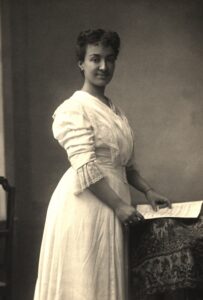
Juliette Folville
Folville’s musical activities in the Liège area attracted the attention of musician and patron Louisa de Mercy-Argenteau, who took a keen interest in the young girl’s career and quickly declared herself her musical ‘godmother’: Folville spent several periods composing at her estate in Argenteau, near Liège. The countess introduced her to the music of the ‘Russian Five’, of which she was an ardent supporter, and introduced her to Alexander Borodin (her musical ‘godfather’) and César Cui. The latter became an important figure in Folville’s life, and the two maintained a regular correspondence until his death in 1918.
Encouraged by her success, Folville decided in 1889 to apply for the Belgian Prix de Rome, as any aspiring young composer would have done. The application caused quite a stir, since no woman had ever competed before. After much debate, the members of the Académie royale, which was responsible for the competition, decided to allow women to participate: indeed, there was nothing in the rules to prevent them from doing so. However, Folville’s second request, for special accommodations – she wanted to be accompanied by her mother as chaperone – was refused on the grounds of preserving fairness between candidates, an argument that seems fallacious in a society marked by gender differentiation, particularly in terms of morality. Faced with this refusal, Folville withdrew her candidacy.
The following year, the premature death of the countess, then of her father, left her solely responsible for her mother, Émilie. Although she managed to complete and stage her opera Atala, dedicated to her father, in 1891, she had no choice but to put composition aside in favor of more lucrative pursuits. The following decade was thus filled with concerts – secured through intensive canvassing of her professional networks – teaching, and recurring frustrations evident in her correspondence. It was only at the turn of the century, when her financial situation improved, that Folville actively and sustainably resumed composing, producing a piano concerto, a Concertstück, and a suite for orchestra.
The declaration of war in 1914 prompted Folville and her mother, like many other Belgians, to emigrate to England, where they settled first in London and then in Bournemouth. They remained there until Émilie Folville’s death in 1929. During these years, the musician made a name for herself as a teacher and, above all, as a performer, collaborating regularly with the Bournemouth Symphony Orchestra and its conductor Dan Godfrey. She was also a regular guest on local radio.
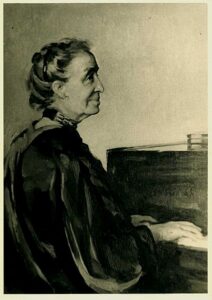 On her return to Belgium, she settled at the convent of the Chanoinesses de Jupille (near Liège), in whose boarding school she had taught before the war. Deeply religious, Folville led a life similar to that of the nuns and devoted herself to teaching, playing the organ, and composing religious pieces for the use of the convent and the adjoining boarding school. It was there that she met the Firket family, whose daughter, Monique, would become one of her main pupils and the curator of her archives. In 1940, they all left Belgium and gradually settled in the south of France. In Dourgne (Tarn), Folville resumed her teaching and musical activities, notably for the local church, where she founded a schola for young girls; she also formed ties with the religious communities based in En Calcat. It was in Dourgne that Folville died in 1946 following a short battle with cancer.
Juliette Folville was not an innovator; nevertheless, her style and catalogue attest to her mastery of the compositional and orchestral practices of her time, and to her genuine talent for musical art. The influence of French composers such as Jules Massenet, Charles Gounod, and Benjamin Godard is evident in her early works, particularly her opera Atala. In her later works, she helped herself to the riches of post-Franckian harmony, tinged with a modality redolent of the Russian school, especially Borodin, the ‘godfather’ of her musical youth and a composer whose influence endured in other works of her maturity. Despite what might be perceived as a certain traditionalism, Folville’s work contains a number of pieces that are worth rediscovering.