
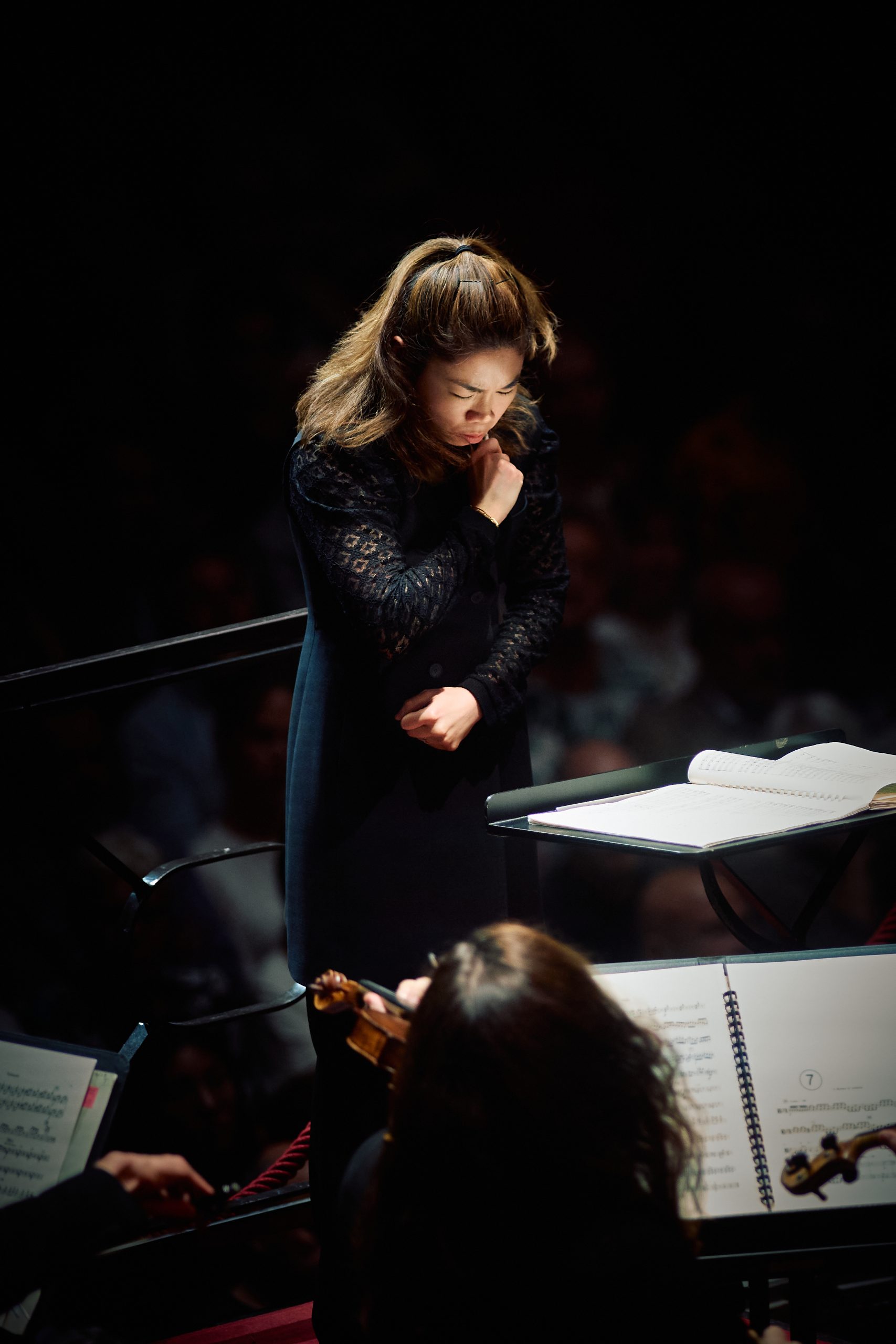
Elim Chan, conductor Photo Credit: Eduardus Lee
Our digest this week has one story Huge news in US orchestras broke just before the holiday weekend: conductor Elim Chan has been named Music Director Designate of the San Francisco Symphony, the orchestra announced on May 21, 2026. Her tenure with the orchestra begins in September 2027. This is a huge achievement for Chan, and we at WPA would like to offer our warmest congratulations!
Chan is breaking some major glass ceilings, as Saul Sugarman of The Bold Italic has pointed out. She is the first woman to lead the San Francisco Symphony as well as the first woman to lead one of the so-called “Big 7” US orchestras—the premiere orchestras who call home the cities of Boston, Chicago, Cleveland, Los Angeles, New York, Philadelphia, and San Francisco. In accepting this position she also marks the first time in San Francisco that the city’s leading Ballet, Opera, and Symphony organizations have all been run by women at the same time. Eun Sun Kim took her post at the SF Opera in 2021 (its first woman music director) and will continue in her current contract through the 2030–31 season; Tamara Rojo has served as artistic director of the SF Ballet since December 2022.
Plenty of news outlets (including most major dailies) have been ready to herald Chan as “the first woman to lead a major American orchestra.” This description is equal parts a testimonial to the changing definition of “major American orchestra” as it is an erasure of previous women conductors and artistic directors. As Katherine Needleman has observed, “I remember twenty-one years ago, in July 2005, when I was also a member of the Baltimore Symphony. Musicians of the orchestra learned that Marin Alsop was appointed to be our next music director in the New York Times. The international press hailed Alsop as “the first woman to lead a major American orchestra.” Before Marin Alsop, JoAnn Falletta also led the Buffalo Philharmonic beginning in 1998, and she was then heralded as the first woman to lead a major American orchestra. Anne Midgette, in her follow-up commentary to the NYTimes coverage, observed that “Xian Zhang, currently music director of both the New Jersey Symphony and the Seattle Symphony Orchestra, as well as Nathalie Stutzmann, the music director of the Atlanta Symphony, must also be wondering, ‘Hey, guys, what the hell does it take for a woman to get on the radar around here?'” I particularly like Needleman’s description that “Everyone wants a ‘first woman.’ But having a ‘first woman’ is not really the Get Out of Jail Free card that so many places are hoping for.” As Needleman explains, “Everyone is right to celebrate the appointment of Elim Chan in San Francisco. It is a step in the right direction… in our industry. But it is just one step after walking around the world for centuries in the wrong direction.”
Get Out of Jail Free Card or not, constantly re-setting the terms on which someone is the “first woman to lead a major American orchestra” helps to undermine a long and growing tradition of women leading American orchestras. If we keep re-setting the clock to “first” then it’s harder for us to recognize the “seconds” and “thirds” necessary to strengthen and build a tradition in the first place. It makes it easier to turn women’s accolades and hard-won advancement in a profession that has fought them at every turn into a kind of shell game. Because the terms of what constitutes a “major American orchestra” keep changing, women who were previously honored as trailblazers on older terms can be erased—subsumed into a simplistic narrative which insists that the “first” is the beginning, with nothing coming before. Chan’s firsts—which I’ve enumerated above—are important and should be celebrated on their own merits. It becomes our duty as listeners with vested interests in the continued advancement of women in classical music to remember that they are the latest in a succession of hard-won achievements and victories.
On Chan’s record of programming and performing work by women composers—a subject of great concern to us at WPA—she has a great record of programing and performing work by younger contemporary women composers, but less so of historical women. Perhaps her position in San Francisco will become an opportunity to change this? She conducted Lili Boulanger’s D’un soir triste on an impromptu program in 2022 after Martha Argerich was unable to perform due to illness. Two contemporary composers whose work she has championed in recent years are Du Yun and Anna Þorvaldsdóttir. She conducted Pulitzer Prize-winner Du Yun’s pipa concerto Ears of the Book in the Philadelphia Orchestra’s area premiere, led the LA Phil in Du Yun’s Thirst, and directed the Antwerp Symphony Orchestra in Þorvaldsdóttir’s Metacosmos. She has also directed several pieces by Elizabeth Ogonek. Chan and Ogonek (here) discuss the process of recording Ogonek’s All these lighted things. And here is the finished recording of Mvt. 1, “Exuberant, playful, bright” from All These Lighted Things:
Elim Chan is beginning what we hope will be a long and fruitful tenure with the San Francisco Symphony. As the city of San Francisco was the base of The Women’s Philharmonic for its 24 illustrious and important years, we also hope she will be inspired by and embrace the legacy of The Women’s Phil, as part of the rich and diverse history of the San Francisco and the Bay Area, as well as a part of the movement to provide equitable opportunities and recognition to women in classical music.