
 We were grateful to have the opportunity to speak with Kristin Jurkscheit, Executive Director of the Taki Alsop Conducting Fellowship, about the tremendous work that the organization has completed over the past 23 years, and the way their work is continuing to grow:
Sarah: I was delighted to hear about this program, and I think perhaps because we work so much on the composer side, it hadn’t been on my radar, so we are so excited to chat with you and find out more about the Taki Alsop Foundation and the work that you do. Tell us more about the history of the organization.
Kristin: Marin Alsop started the fellowship in 2003 as a way to extend a hand to up-and-coming women conductors. Marian and Tomio Taki, who had always been very supportive of Alsop’s work, raised a lot of money so there would be a fund that they could use the interest off of to give out awards, and she would mentor people, and try to provide them opportunities.
The organization had volunteers over the years, but I stepped in to help formalize the organization and grow its impact in 2019. I had all these plans – I redid the website, I talked to all the conductors – but then COVID hit. On one hand, it was really devastating. But on the other, all the conductors were sitting at home, so we started a Zoom series with people from different organizations. Executive directors and conductors had the time and opportunity to have conversations with past fellowship winners, which allowed them, for the first time, to meet each other. This went on for months, and it was so fun!
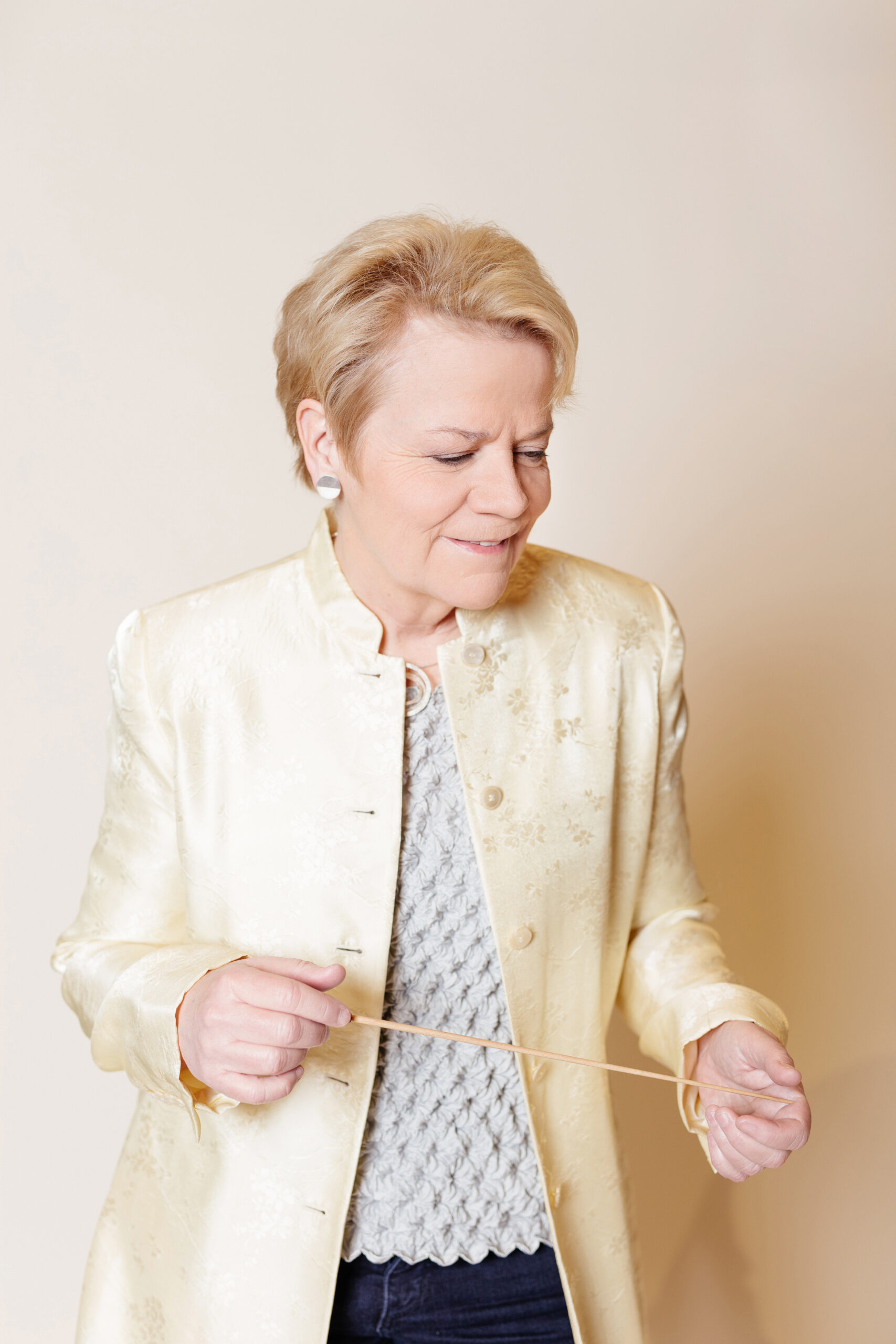
Photo Credit to Theresa Wey
We realized that through these conversations we were building a community. The fellowship winners were so happy to meet each other, and it all sort of shifted after that. At the same time we started to try to find funding so we could do a global concert series for our 20th anniversary, which would also be of help to the orchestras coming out of COVID. We got the funding to provide about $20,000 to ten different orchestras that are led by the conductors who had received the fellowship. We were then able to provide them with an assistant, covering their airfare and travel, so that there was an opportunity for a younger conductor to be mentored. This led to the start of a separate mentoring program.
We also host a conference every year. Right now it occurs at Ravinia because Marin is the Chief Conductor there. We raise money to help conductors with airfare and hotel, which is so important since many of our conductors travel from Europe. Marin also works to find conducting opportunities for the fellows, award winners, and mentees at the festival.
The Mentoring Program just finished its third year with a ten conductor cohort.They do not receive one-on-one mentoring from Marin but do receive 10 mentoring sessions from TACF alumni. And now they’re all meeting each other, and they’re making connections, and connecting and staying connected. The community of these conductors is very supportive, with more established conductors offering opportunities to those earlier in their careers. It’s really fun to watch. And I feel like now, more than ever, this community is so important.
I think the larger push for gender equality, for DEI, has greatly diminished from administrative spaces. Now, it’s just not a priority. Maybe it was briefly, but I feel like it is not anymore.
Sarah: On that note, we live in such a difficult time, a difficult place regarding attitudes of deliberate inclusion – have you noticed any direct results of the actions or priorities of the Federal administration in the ways in which the Foundation is received?
Kristin: Well, a couple things have happened that have been disturbing, because we have conductors from everywhere, all over the world. We have a conductor who came to study with Marin. She is originally from Cuba. She was in Spain when she applied, she didn’t get in the fellowship that first time, but Marin said, come study with me at Peabody. Long story short, she was an excellent student, she’s a great conductor, quick learner and a hard worker. She won the assistantship job with a symphony out west. But just a month ago or so she got a letter saying, “You have 15 days to leave the country.”
Ironically, Marin had met a Republican congressman who was a big fan, and we reached out to him, and he was very helpful. This conductor is in compliance, she did finally get a work permit, and she got a letter from ICE and DHS saying she’s allowed to be in the country, but it’s stressful, and she’s exhausted from this.
We have another conductor who is from Brazil and legally here with a Green Card. She came back from Europe, and Customs and Border Protection wouldn’t let her use her Global Entry, and they wouldn’t let her use her Green Card. She had to come in on the passport. So she’s got a lawyer, and they’re trying to figure this out, because she lives here. She’s a music director at a symphony in Washington state. She has a home here, her partner is here, she just bought a house. We’ve noticed this is becoming more problematic. We have conductors who are a little scared to come to the U.S. for the conference.
The Taki Alsop Conducting Fellowship is currently in the midst of a large fundraising effort. The goal is to secure $8 million for an endowment that will ensure the security of fellowship so that it will thrive for decades to come. The goal has never been to create a large non-profit, but to support emerging conductors and encourage them through the still difficult terrain of leading orchestral ensembles as a woman.
Kristin: Our established conductors are currently working with incoming mentees, and we’re watching more and more to see who is a good mentor, which conductors would be good choices as a succession plan if Marin wants to step back. There isn’t just one person, I don’t think, that would take on the whole role that Marin has.
We hold an application every two years, and how many awards we give out depends on the pool of candidates. We know there will be at least one fellow, but sometimes have one associate fellow, or two. Or award recipients who really should have a little something, because they’re really talented, but they’re not quite ready to be the fellow. So we base it on what’s available, what the pool is, and then also what kind of opportunities we think we can provide for them. Part of the consideration of candidates is thinking about what we can offer and having enough of a balance with masterclasses, conducting, and other professional opportunities. We always try to make sure everybody’s getting what they need when they need it, and to be flexible in that way.
One of the areas that’s really lacking when it comes to talking about women in the conducting field is some serious research. It’s one of the reasons I value the work that you do in providing repertoire reports. There are so many questions that need to be addressed. How many women are music directors? How many women are conducting in the US? I feel it’s important to look globally at who is conducting orchestras.
Sarah: Exactly. For example, the information recently published by the League of American Orchestras is inaccurate and provides a false sense of progress that isn’t actually being made. The statistics that are publicly available include conductors of youth orchestras and ensembles in colleges and universities, both of which are predominately female, but they don’t disclose that information. It gives a false impression that the field is more diverse than it really is. It’s wonderful that women conductors have positions in youth and academic orchestras, but it’s important to recognize that they still largely aren’t on podiums of professional ensembles. This research is so important, and hard to do, because we can’t speak to there being a problem when you don’t have the data to prove it.
Kristin: Everybody’s seeing some women on the podium, and they’re basically saying, “I don’t see what the problem is, you guys are good.” While, yes, improvements have been made, women still largely don’t hold music directorships, they don’t have the status, and are not awarded the same opportunities as men. We have also been focusing our work on the impact women conductors make on women as leaders. When you see a woman on the podium you are seeing a woman in charge, and in order for things to change for women across industries, society needs to see that. When you see a woman conducting 80-200 people, it makes a public and visual statement: that women can and should lead.
Look for a future post that highlights women who have benefitted from the fellowship and the projects that are forging new paths in the field of classical music.