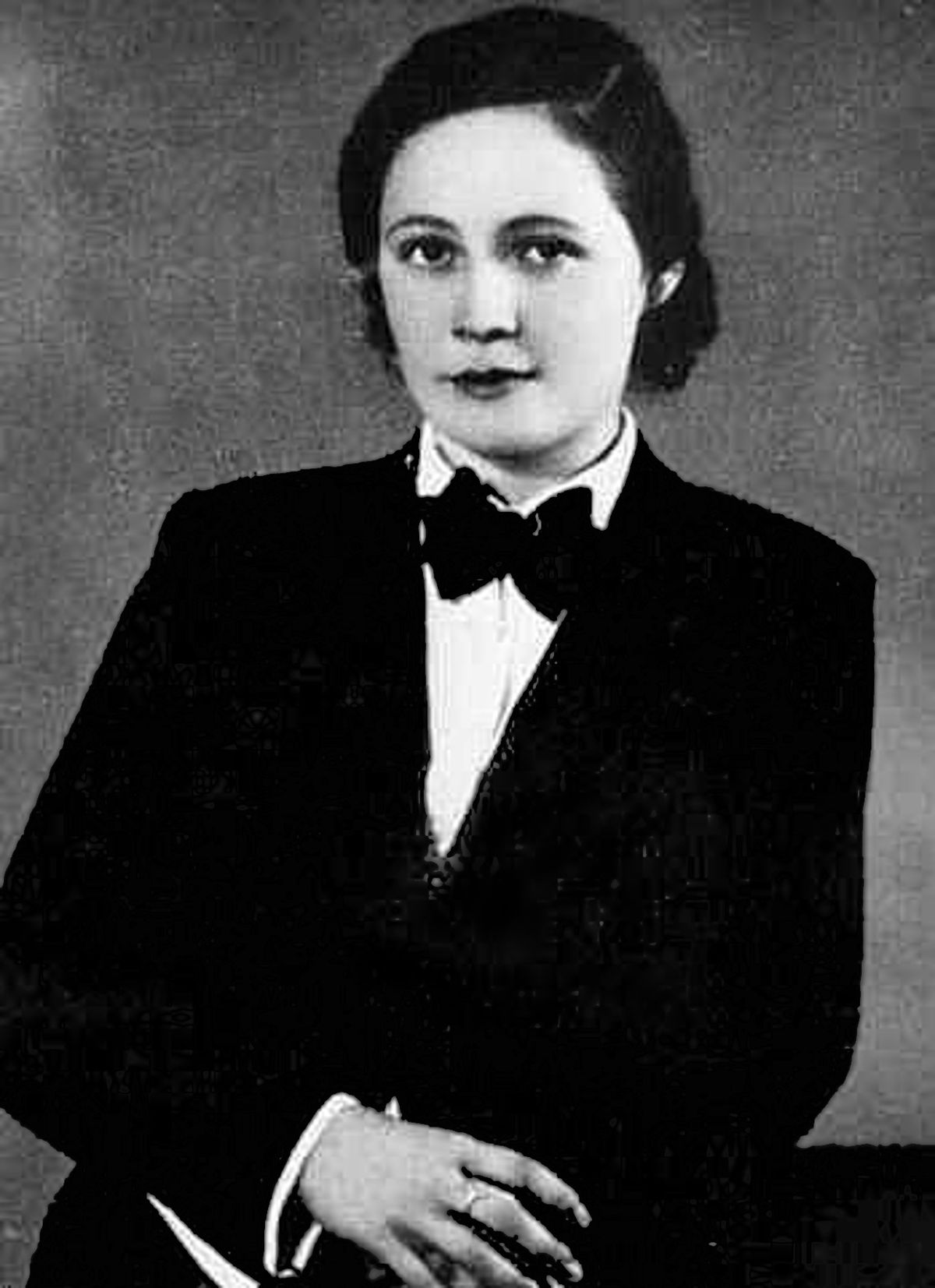
Vítězslava Kaprálová.
Vítězslava Kaprálová (1915-1940) was a Czech composer and conductor of 20th-century classical music. She was a daughter of composer Vaclav Kapral and voice teacher Vitezslava Uhlirova. A child prodigy, she started composing at nine, and at fifteen she entered the Brno Conservatory where she studied composition with Vilem Petrzelka and conducting with Zdenek Chalabala and Vilem Steinman (1930-1935). She continued her studies with composer Vitezslav Novak and conductor Vaclav Talich at the Master School of the Prague Conservatory (1935-1937), and further advanced her musical education at the Ecole normale de musique in Paris with Charles Munch (1937-1938) and, according to one account that has yet to be verified, with Nadia Boulanger (1940), while also studying composition privately with Bohuslav Martinu (1938-1939). In 1937, Kapralova conducted the Czech Philharmonic and a year later the BBC Orchestra in her Military Sinfonietta, to much critical acclaim. Despite her untimely death in 1940, possibly from typhoid fever, Kapralova left behind an impressive body of work. Her music was much admired by Rafael Kubelik who premiered her orchestral song Waving Farewell and performed several other works; so did Rudolf Firkusny, for whom Kapralova composed April Preludes and Two Dances for Piano. In 1946, in appreciation of her distinctive contribution, the foremost academic institution in the country – the Czech Academy of Sciences and the Arts – awarded Kapralova membership in memoriam. By 1948 this honor was bestowed on only 10 women, out of 648 members of the Academy. Only one of the ten women was a musician – Kapralova.
For more information visit kapralova.org