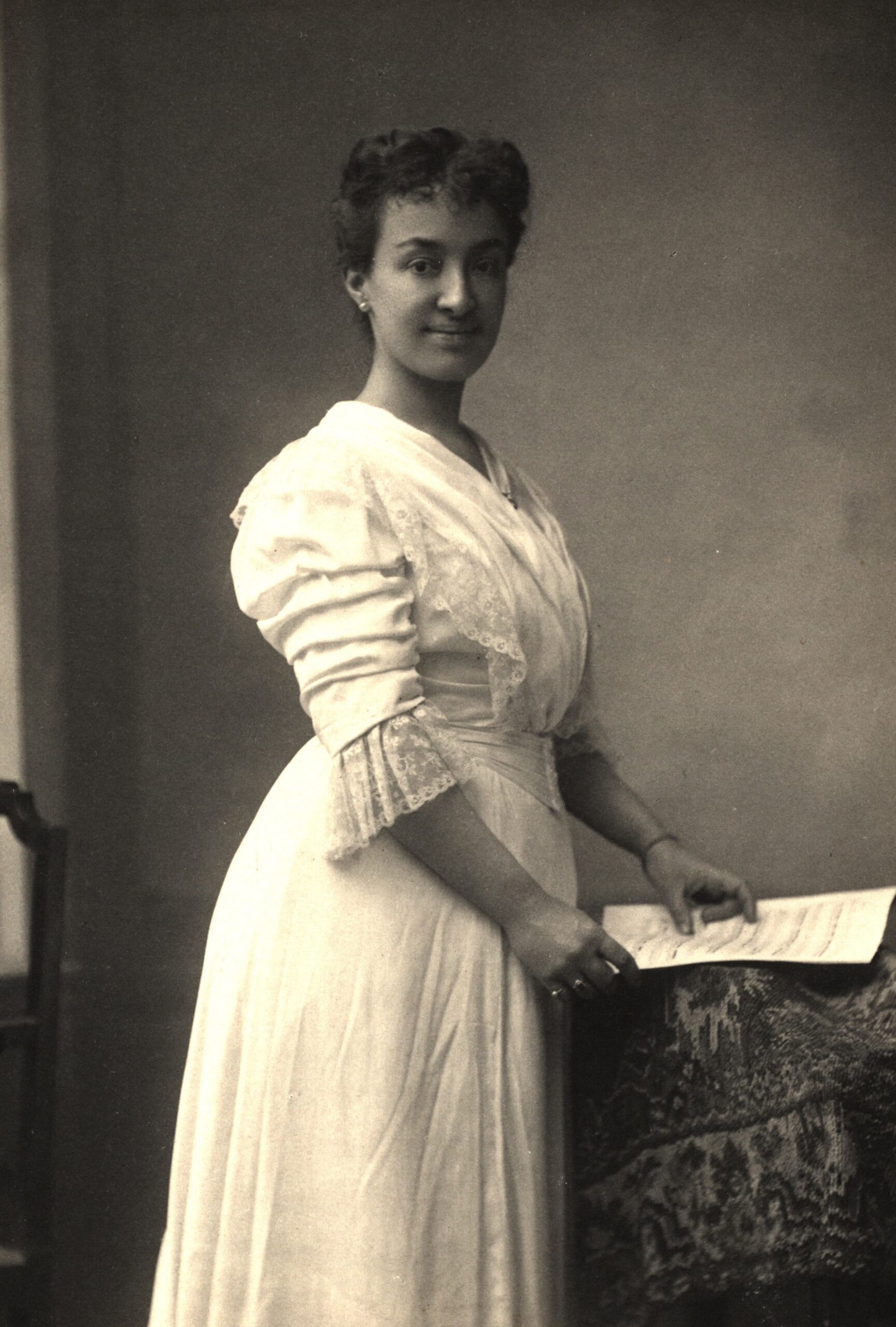
Juliette Folville.
The Belgian composer Juliette Folville (1870–1946) had some success in her lifetime, and left a considerable output, most of which remains to be rediscovered today. She began her musical career as a child prodigy on the piano and violin, performing at charity concerts in the Liège area. She soon branched out into composition, honing her craft in the 1880s in the class of Jean-Théodore Radoux, director of the Royal Conservatory of Liège and a friend of the family. Contrary to the customs of the time, Folville owed her precocious beginning to the special attention of her father, who supervised her early musical training. Jules Folville, a successful lawyer, was an enthusiastic amateur musician and actively supported his daughter’s career by providing her with a comfortable financial situation and organizing numerous concerts for her. The budding composer also benefited from the patronage of Countess Louisa de Mercy-Argenteau, who introduced her to various national and international artistic networks, in particular that of the ‘Russian Five’, whose music she promoted. Thanks to this enviable situation, Juliette Folville was able to compose several major works as early as the 1880s, including three orchestral suites, a violin concerto, and a cantata. In 1889 she was the first woman to try to compete for the Belgian Prix de Rome, an ambition ultimately abandoned for moral reasons: the Royal Academy would not let her be accompanied by chaperone nor arrange any special accommodation for the month-long stay at the conservatory imposed on the candidates.
Her father’s untimely death in 1890, and the debts he left behind, placed the single child Folville in a precarious financial situation, forcing her to devote herself to the more lucrative pursuits of performance and teaching to sustain both her and her mother. Surviving correspondence show her actively promoting herself and her work to impresarios and concert halls across Belgium and neighboring countries. Her relationship with the Conservatoire royal de Liège and director Jean-Théodore Radoux allowed her to perform regularly on the
institution’s stage, as both a soloist and conductor. Though she completed her opera Atala in 1891, her musical output slowed significantly in the 1890s, for lack of time. In 1894, the composer César Cui, a regular correspondent of hers, encouraged Folville to ‘compose on the tram and on the train’; Radoux similarly urged her not to ‘let teaching take over everything else’. A growing frustration with her financial situation and inability to devote herself to composition nevertheless comes through in Folville’s correspondence from this period.