
There’s lots of music by women to listen to and read about this week!
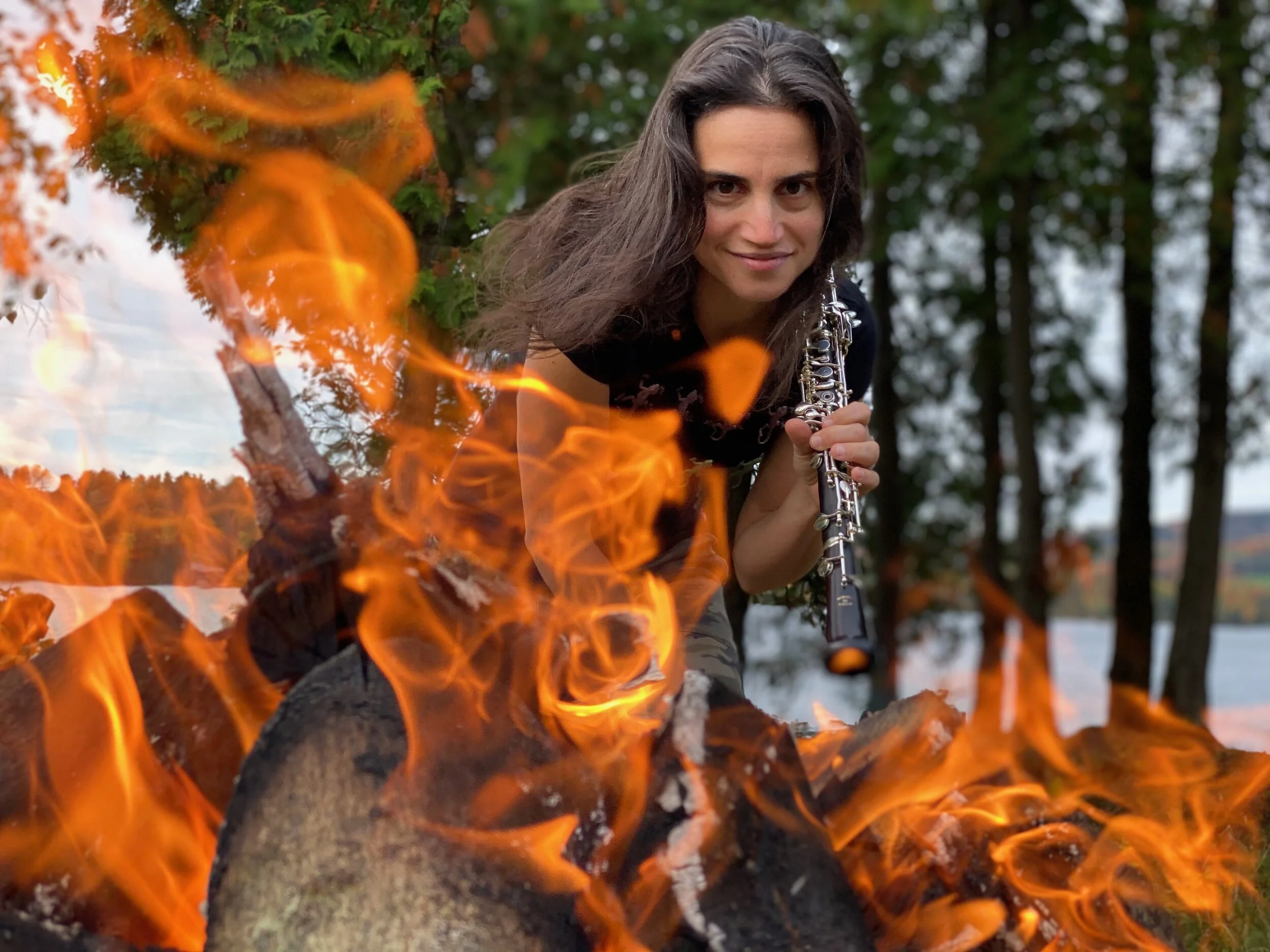
Katherine Needleman: oboist, composer, writer, & activist. Photo courtesy of the artist, pictured destroying patriarchy.
Before covering upcoming events this week, Katherine Needleman—professional oboist and principal of the Baltimore Symphony Orchestra; composer and improviser; writer and tireless activist for women in classical music—has had a full slate of material for reporting this summer. For those who do not already know her work, Needleman “writes widely about classical music and its power structures and maintains a blog and social media presence of some notoriety.” She particularly focuses on the hierarchies of power in institutions of classical music (including, but certainly not limited to, orchestras), how they continue to consolidate their power in the hands of Big Fancy Men™ in the 21st century, and advocating for women who live and work in these institutions. She has extensive personal experience in it, of course, but also includes the experiences of her colleagues and historical women.
Her recent coverage and reporting is necessary reading for those who are invested in the future of classical music. Needleman’s work is regularly available through her Facebook page and by subscription via her Substack newsletter. Thank you Katherine for your continued work and dauntless advocacy, particularly for women.
- July 15th: more men behaving badly in classical music. (Queen of Filth Digest #17)
- July 16th: Goings-on at the Boston Symphony, and the asymmetric nature of conductor-musician relations (Veuve Clicquot-Gate).
- July 19th: The BSO has programmed only three works by women for the 2026–27 season, and none of them are second-half or headlining pieces (i.e., they’re shorter and smaller-scale than the works by men.) She crunches the numbers to find that “next time someone tells you the BSO is an equal-opportunity meritocracy that just happens to keep landing on men, you can show them the math: three composers, two conductors, and three individual soloists. All season long. That’s a pattern, that’s a quota system for men, and it has a spreadsheet behind it.” (The Real Scandal at the Boston Symphony, The One Nobody’s Got a Flower or a Chant For.)
- July 20th: the ongoing case of Julian Wachner—connected to Trinity Wall Street, Juilliard, and the Concerto Vocale Foundation—for sexual assault, purchase and possession of child sexual assault materials (CSAM), and child custody. (BFMs Gone Wild: Julian Wachner Pleads Guilty.) ***This reporting contains material that may be disturbing to some readers. Needleman exercises her proven judgement in striking a balance between not sugarcoating genuinely grim truths while also not gratuitously re-hashing details. Please use judgement while reading, and care for yourself.
- July 25th: Tanglewood management discouraging audience members from showing solidarity with the orchestra (Policing Flowers)
- July 29th: Interlochen’s release of its investigation into the history of sexual harassment and abuse of its students at the institution, particularly some analysis that is not making the news cycle. “It’s not just Interlochen, Curtis, and Cleveland Orchestra—all of whom have made their reports public—who have these problems. It’s not just the Royal Conservatory in Toronto who has yet to commit to making their report public. It’s basically every orchestra and every music school. If you think your institution doesn’t have these problems to reckon with, I think you are deluded. And I understand that being deluded is comfortable—really, I do.” (46 of 47.)
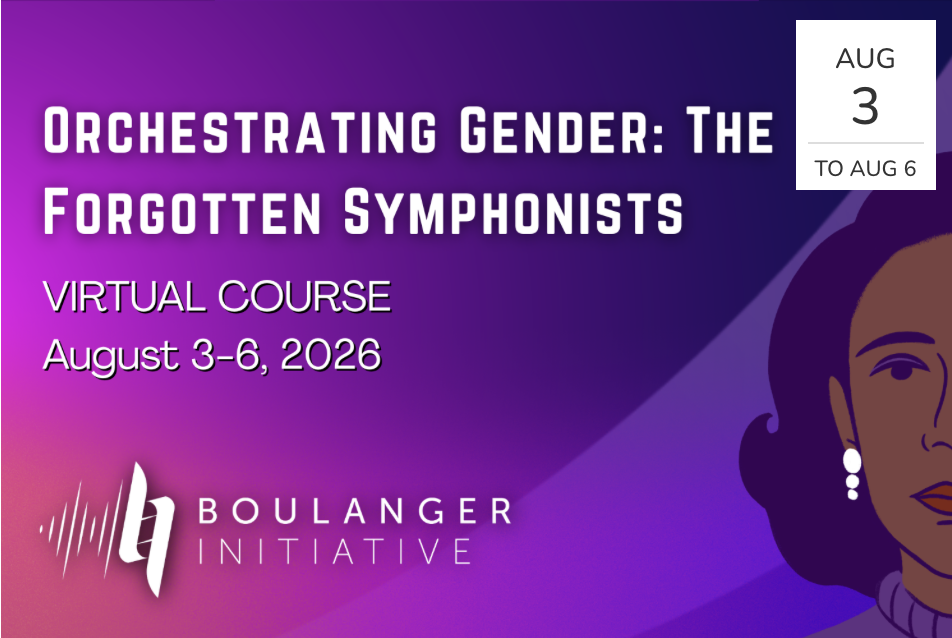 From August 3–6, the Boulanger Initiative presents its virtual intensive course “Orchestrating Gender: The Forgotten Symphonists.” Women’s Philharmonic Advocacy supporters receive 25% off with code: WPA at registration. Composers covered in the course include: Marianna Martines, Louise Farrenc, Emilie Mayer, Augusta Holmès, Florence Price, and Julia Perry, among others. The course facilitators write that the virtual course “traces the evolution of the orchestra through the women who were there from the beginning with guided discussion, listening excerpts, and practical tips for discovering overlooked repertoire.” Participants will have opportunities to explore works that were previously celebrated or popular that were later erased during canon formation. There will also be plenty of material placing these composers in their cultural, historical, and artistic contexts. Workshops will also examine how the forces of institutions, pedagogy, and power have shaped ideas of what qualifies as “great music.” Fuller partial financial aid is available, and participants may choose from synchronous or asynchronous formats.
On August 7th, the Pacific Northwest Conducting Institute (PNWCI) returns to give its annual Summer Festival Concert. The performance features the 2026 conducting fellows who will lead the Saratoga Orchestra of Whidbey Island, WA. Works performed include Smyth’s Serenade in D Major for Orchestra and Gabriela Lena Frank’s Elegia Andina (2000). The program is led by internationally acclaimed conductor, composer, and educator Diane Wittry and Dr. Anna Edwards.
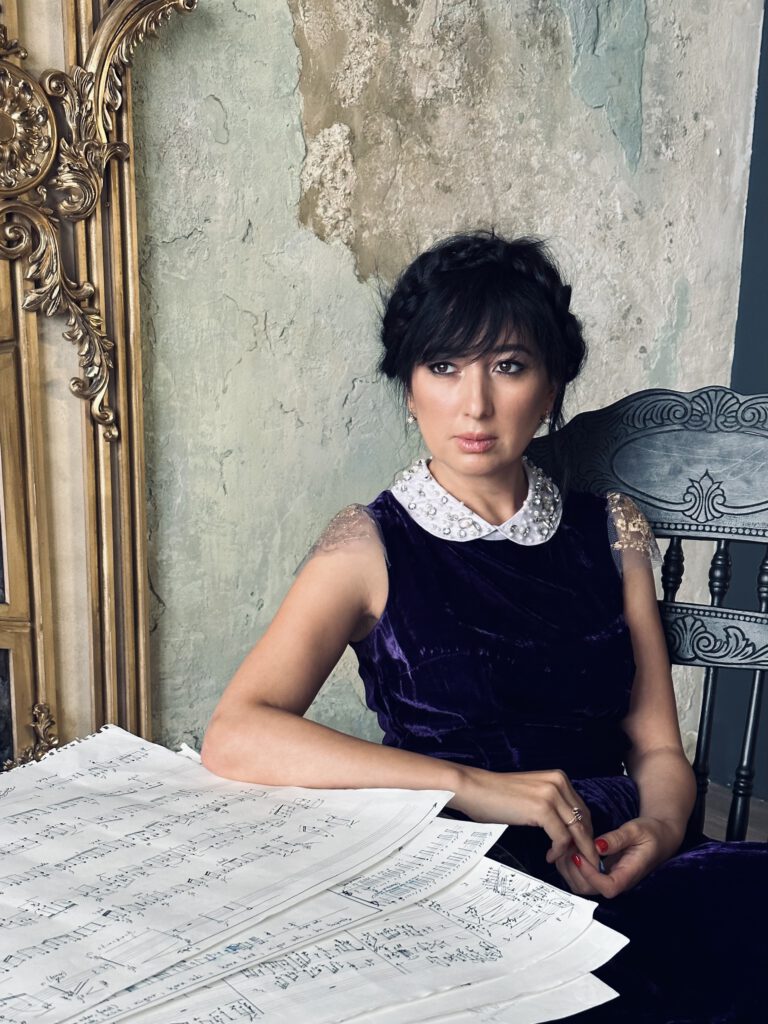
Aziza Sadikova, composer
On August 4th, the Orchestre Visionnaire will premiere Aziza Sadikova‘s Tuba aeterna sonora, commissioned by the Concertgebouw. It will appear alongside a Chopin Piano concerto and a Mendelssohn symphony. The past few years have been remarkably productive for Sadikova’s orchestral music, particularly for concertos, and 2026 has been an important year for revisions. Her 2026 output includes: Farbenzeiten (Colour Times), based on Vivaldi´s 4 Seasons; Stradivari; Concerto for 2 double basses and chamber orchestra; Angelo di Fuoco for orchestra; and Rigo and Rosa.
She describes her music as exploring “different sides of music, ranging from various instrumental techniques and experiments with music theatre (Ein Brief, Silberklang, opera Alles über Sally), or being influenced by dramatic and expressive dramaturgy of Romantic masters (Angelo di Fuoco, Lichtscherben), towards depicting elegant stylistic textures of music of Neo-Baroque (Vivaldi New 4 Seasons FARBENZEITEN, Marionettes, Sonata for Giuseppe Tartini), or children’s music fairytales (Rigo and Rosa, Sterntaler).”
Below is a recording of Sadikova’s Angelo di fuoco (revised 2026) for orchestra, performed in its original version by the Toscanini Philharmonia in 2023.
On August 4th, the Peninsula Music Festival of Door County, WI performs Joan Tower’s Tambor (1998) on their “American Masterworks” concert. Originally commissioned by the Pittsburgh Symphony Orchestra, Tambor draws on Tower’s formative years spent in Bolivia. She writes that “the strong role of the percussion [during the composition process] began to influence the behavior of the rest of the orchestra to the point that the other instruments began to act more and more like a percussion section themselves.” (Composer’s notes, Schirmer score edition.)
Below is a performance of Tower’s Tambor by the Nashville Symphony Orchestra, directed by Leonard Slatkin. Their recording is also available on the NAXOS label.

On August 5th, Manchester’s Hallé orchestra directed by Kahchun Wong perform Nadia Boulanger’s Fantasy for Piano and Orchestra (1912) at the BBC Proms with featured soloist Alexandra Dariescu. The concert marks Dariescu’s Proms debut as well as her status as the first Romanian female pianist to appear at the festival. She is an ongoing champion of Boulanger’s work, having been favorably reviewed in performing it. The Fantasy has in the past collected all the kinds of critical description that have tended to follow large works by women composers, including that it is “juvenile” (Boulanger was 25 when she wrote it), “incoherent,” and the product of a musical voice that needed more time to develop. Under Dariescu’s fingers we can hope to hear young Nadia—while she was still composing, and before her fame as a teacher eclipsed all her other work—at her best.
Applications are now open to join the League of American Orchestras’ Virginia B. Toulmin Foundation Orchestral Commissions Program, a partnership with American Composers Orchestra (ACO) for the 2027–2028 season. Final applications are due on August 13, 2026. Composers, lead orchestras, activities, and participation requirements are available on the League website.
Let us know who you’re listening to! Use our handy website contact form!